

Market Report · June 2026June 2026 Southern Ontario Real Estate Market Report: What's Really Happening Across the GTA, Hamilton & Waterloo RegionSales up, listings down, prices
June 2026 Southern Ontario Real Estate Market Report: What's Really Happening Across the GTA, Hamilton & Waterloo Region
Sales up, listings down, prices still soft — is the market finally turning?
Executive Summary
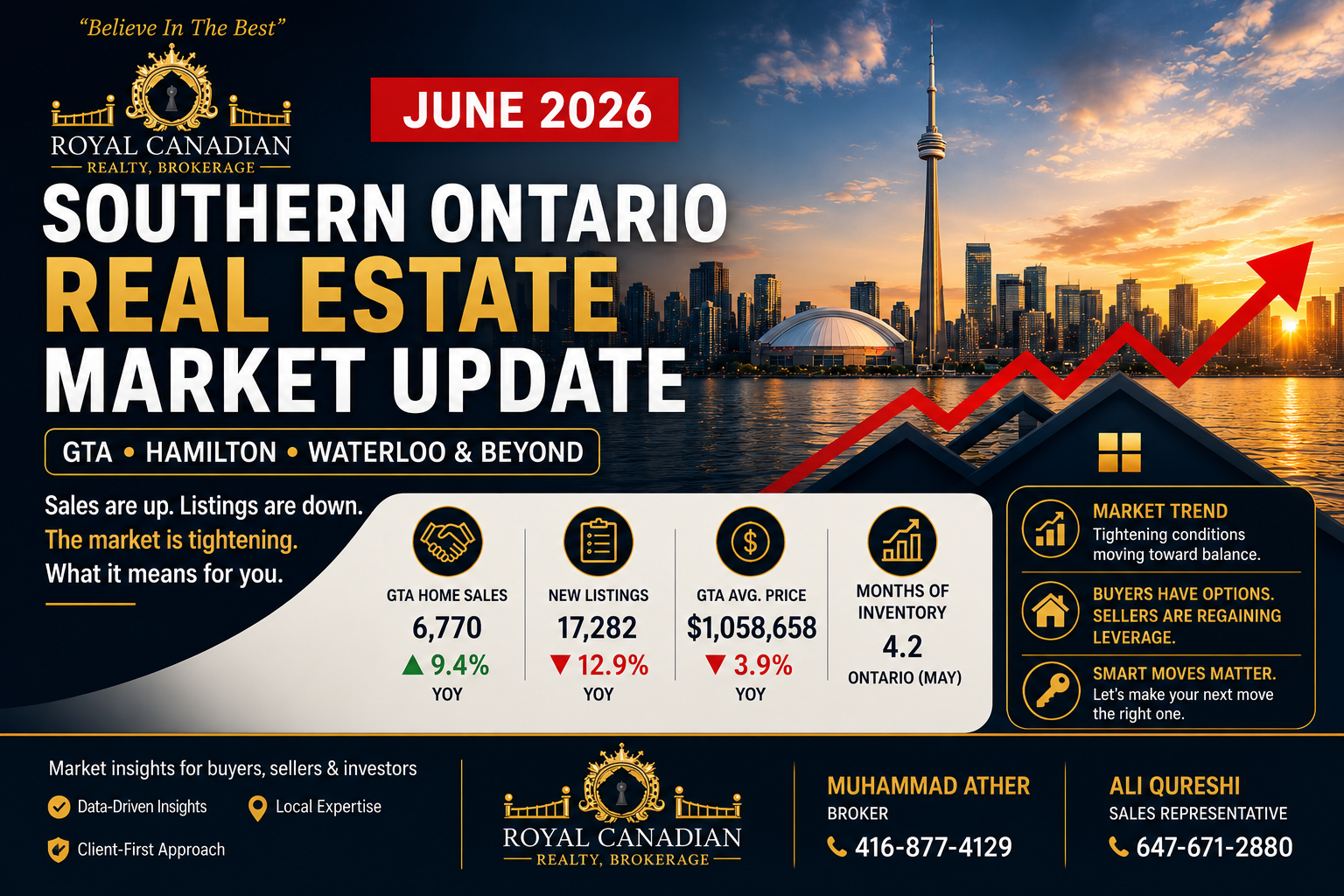
The June 2026 market answer, in plain language: firmer, but not fully balanced. Sales improved, new listings fell, and prices stayed below last year's levels — though the rate of decline narrowed noticeably across the GTA. Inventory is still elevated versus long-run norms, so buyers have options, but the recent tightening suggests sellers are regaining leverage in the best-priced, best-located segments.
6,770
GTA Home Sales
June 2026
June 2026
+9.4%
Sales vs.
June 2025
June 2025
$1.06M
Avg. GTA
Selling Price
Selling Price
−3.9%
Price Change
Year-Over-Year
Year-Over-Year
17,282
New Listings
(down 12.9%)
(down 12.9%)
4.2 mo.
Ontario Months
of Inventory
of Inventory
GTA Market Direction: Gradually Tightening
TRREB recorded 6,770 GTA home sales in June 2026, up 9.4 per cent from June 2025, while new listings fell 12.9 per cent to 17,282 — a combination that usually improves seller confidence over time. The average selling price was $1,058,658, down 3.9 per cent year-over-year, but the annual rate of decline has been easing in recent months.
"This isn't just a weak market — it's a market recovering from weakness. Fewer price cuts are needed to move listings, and more buyers who had been sitting out are returning with confidence."
Inventory also tightened. Seasonally adjusted sales rose month-over-month while new listings fell, and Ontario's broader May market carried 4.2 months of inventory — above the long-run average, but noticeably lower than earlier in the spring. That's not a seller's market yet, but it's far from the oversupplied conditions seen when listings were piling up faster than demand.
Ontario & National Picture
Ontario's May average resale price was $847,813, down 1.5 per cent year-over-year, with new listings down 12.7 per cent and active listings still 28.7 per cent above the five-year average. Nationally, CREA reported May sales up 5.5 per cent month-over-month, 4.8 months of inventory (close to the long-run average of five), and an average price of $702,079, up 1.5 per cent year-over-year.
Regional Breakdown: Where Does Your Market Stand?
Toronto & Peel Region (Mississauga, Brampton)
Toronto remained one of the busiest parts of the region, with 2,443 sales and an average price of $1,081,375 in June. The city still commands the largest buyer pool, but the market is more selective than competitive overall — well-priced homes move, while overpriced listings tend to sit.
Mississauga and Peel Region weren't broken out separately in this month's data, but the broader GTA trend applies directly: fewer listings and rising sales tend to improve confidence first in high-demand, transit-connected areas.
York Region (Markham, Vaughan, Aurora, Newmarket, King City)
York Region stood out as one of the stronger family-home corridors in June, with 1,289 sales and an average price of $1,169,958. Communities like King, Aurora, Vaughan, Markham, Richmond Hill, Newmarket and Stouffville continue to attract buyers seeking larger homes, good schools, and long-term value.
York Region Buyer Tip
With detached demand tightening fastest here, the most important question is still "Is this specific home priced for today's market?" — not "Are prices rising?"
Durham Region (Pickering, Ajax, Whitby, Oshawa, Clarington)
Durham remains the GTA's most important affordability-pressure valve. In a market like June 2026, that tends to mean more attention on entry-level detached homes, semis and townhomes — especially where the commute trade-off is acceptable and the home is move-in ready.
Halton Region (Milton, Oakville, Burlington)
Milton real estate market June 2026 and Oakville real estate market June 2026 sit within Halton, a premium suburban corridor with strong detached demand and tighter resale supply. In a market where prices are still below last year but listings are thinning, Halton can reprice faster than the broader region once buyers sense fewer concessions are on offer.
Hamilton
Hamilton house prices June 2026 sit between GTA affordability pressure and local end-user demand. The June GTA-wide trend of more sales momentum and less new supply tends to benefit balanced markets like Hamilton first — especially where pricing is still below prior-year highs and buyers remain highly value-conscious.
Waterloo Region: Improving Without Reaching Historic Norms
The Waterloo Region real estate update June 2026 offered one of the clearest third-party pictures this month:
- 676 homes sold in June — up 0.3 per cent year-over-year, but still 21.7 per cent below the ten-year June average
- About 4.0 months of supply at the end of May
- Average price of $744,032 — down 5.8 per cent year-over-year
- Kitchener-Waterloo HPI at $649,200 — down 6.5 per cent year-over-year
- Cambridge HPI at $676,100 — down 7.2 per cent year-over-year
Waterloo remains relatively balanced, but the region's benchmark price signals were softer than the sales headline alone suggests — a reminder that activity and value don't always move together in the same submarket.
"For anyone asking 'Is Waterloo Region still balanced?' — yes, roughly, but the benchmark price data tells a more cautious story than the sales count on its own."
| Metric | June / May 2026 Read |
|---|---|
| Sales | 676 in June, up 0.3% year-over-year |
| Average price | $744,032, down 5.8% year-over-year |
| Supply | About 4.0 months by end of May |
| Kitchener-Waterloo HPI | $649,200, down 6.5% year-over-year |
| Cambridge HPI | $676,100, down 7.2% year-over-year |
Property Type Breakdown: Who Has the Edge?
Not every property type is moving at the same pace in summer 2026. Here's the honest breakdown:
| Property Type | June 2026 GTA Avg. Price | YoY Change | Buyer/Seller Edge |
|---|---|---|---|
| Detached | $1,364,204 | −2.0% | Most Resilient |
| Semi-Detached | $1,038,973 | −4.6% | Balanced |
| Townhouse | $844,579 | −3.1% | Balanced |
| Condo | $630,688 | −9.5% | Strong Buyer Edge |
Detached pricing's smaller year-over-year drop reflects more resilience in freehold segments, while condos continue to show the softest pricing — better choice for buyers, but slower absorption in high-supply pockets. Townhomes and semis sit in the middle: move-up housing is still pressured, but more stable than the condo segment.
What's Influencing the Market? Key Factors for Summer 2026
- Interest rates and affordability are becoming more aligned — buyers appear to be adapting to financing conditions rather than waiting for a perfect rate environment.
- National momentum — CREA reported May 2026 sales up 5.5 per cent month-over-month, with Ontario activity improving for a fourth straight month on a monthly basis.
- Supply is the bigger story — Ontario new listings fell 12.7 per cent year-over-year in May, though active listings remained 28.7 per cent above the five-year average.
- National comparison — Canadian inventory ended May at 4.8 months, close to the long-run average, helping explain why Ontario still feels softer than some other provinces even as the floor firms up.
The Story Beneath the Headline
Sales rising while listings fall is exactly the setup that tends to tighten a market over time — but Ontario's elevated active-listing count means that shift is still gradual, not sudden.
Market Sentiment: April → May → June 2026
The spring-to-summer arc tells a clear story about shifting psychology in the market:
April 2026
Better spring follow-through. Sellers pricing against competition, not optimism.
May 2026
National and Ontario sales improved for a fourth straight month, but caution remained.
June 2026
Sales up, listings down, price declines narrowing — the clearest tightening signal of the year so far.
"Buyers are asking for value, not just discount. Sellers are asking for proof, not hope. That's why renovated detached homes, well-located semis and competitively priced townhomes are moving faster than dated condos or overleveraged listings."
Q3 & Q4 Outlook: What to Expect for the Rest of 2026
The most likely Q3 2026 scenario is a market that becomes a little more competitive, especially if sales continue to outpace new listings. TRREB expects more competition between buyers in the second half of the year, and June's figures already support that view.
For Q4 2026, the key question is whether tightness in the best segments starts to show up in broader price growth. If it does, the first signals will likely appear in freehold homes in Toronto, York, Halton, and selected Hamilton-Burlington neighbourhoods, while condos may lag given still-heavy supply.
Is It a Good Time to Buy or Sell This Summer?
Buyers: Real leverage and selection remain — especially in condos and still-heavy-supply pockets.
Sellers: Well-priced, market-ready homes are starting to be rewarded by the improving sales trend.
Investors: Watch the gap between headline averages and submarket reality — a condo-heavy pocket with weaker price trends needs a different approach than a tightening detached-heavy family area.
Frequently Asked Questions: June 2026 Southern Ontario Real Estate
Is Southern Ontario in a buyer's market in June 2026?
It's mixed and buyer-leaning overall, but moving toward balance. Sales are rising while new listings are falling across the GTA, which is exactly the combination that typically shifts a market away from a deep buyer's advantage.
Are home prices rising or falling in June 2026?
Prices are still down year-over-year across the GTA and Ontario, but the declines are getting smaller. The GTA average price was $1,058,658 in June, down 3.9% from June 2025, while Ontario's May average resale price was $847,813, down 1.5% year-over-year.
Which GTA regions are strongest right now?
York Region stood out for detached, family-home demand with an average price of $1,169,958. Halton (Oakville, Burlington, Milton) also tends to reprice faster than the broader market once buyers sense fewer concessions are available.
Is Waterloo Region still a balanced market?
Largely yes. Waterloo Region had about 4.0 months of supply at the end of May, with 676 homes sold in June (up 0.3% year-over-year) and an average price of $744,032, down 5.8% year-over-year.
Is it a good time to buy or sell this summer?
For buyers, yes if the goal is leverage, selection and negotiating room. For sellers, yes if the property is well-priced and market-ready, since the improving sales trend is starting to reward strong presentation.
How Team Home Axe Helps in This Market
Execution matters more when conditions are mixed, and June 2026 is a mixed market. In a region where sales are rising, listings are falling, and pricing is uneven across Toronto, Peel, York, Durham, Halton, Hamilton and Waterloo, clients need real-time market reading, negotiation discipline, and pricing that reflects actual supply-demand conditions — not last year's numbers.
- For buyers: Identifying where negotiation room still exists and which neighbourhoods are already firming.
- For sellers: Pricing strategy, staging discipline, and a clear plan for handling competing offers or a quiet listing.
- For investors: Reading the gap between headline averages and submarket reality — especially where a condo-heavy pocket and a tightening detached-heavy area require very different approaches.
Team Home Axe
Sharp Moves. Smart Homes.
Serving Southern Ontario
GTA · Halton · Peel · York · Durham · Waterloo · Hamilton
Our Offices
Mississauga
Unit 1 – 2896 Slough St, L4T 1G3
Unit 1 – 2896 Slough St, L4T 1G3
Markham
Suite 206 – 3 Centre St, L3P 3P9
Suite 206 – 3 Centre St, L3P 3P9
Kitchener
Suite 2B – 625 King St E, N2G 2M2
Suite 2B – 625 King St E, N2G 2M2
Hamilton
Suite 300 – 163 Centennial Pkwy N, L8E 1H8
Suite 300 – 163 Centennial Pkwy N, L8E 1H8
 Toronto Real Estate Board (TRREB); All information deemed reliable but not guaranteed. All properties are subject to prior sale, change or withdrawal. Neither listing broker(s) or information provider(s) shall be responsible for any typographical errors, misinformation, misprints and shall be held totally harmless. Listing(s) information is provided for consumer's personal, non-commercial use and may not be used for any purpose other than to identify prospective properties consumers may be interested

